
We have spaces in our Youth Steering Group - Come and join us!
WGP Charity number: 1201507
200 Acres of high pasture, hill land and peat bog in Garsdale, Cumbria
Like most areas of the world Cumbria and the Yorkshire Dales has seen, and continues to see, habitat and species decline.
There is a continuous quest for a balance between farming, industry, development, tourism and conservation and the regeneration of our natural environment
Wild Garsdale Pike works with young people giving them a voice and the opportunity to explore conservation and environmental issues and gain practical conservation and research experience.
We have a permanent Youth Steering Group of young people aged 13 - 25 years, who make 10 or more visits a year. Working with the trustees, they have ownership over the project and contribute to the decisions we take.
We also host local schools, community groups and charities working with young people, giving them the opportunity to get involved in conservation and practical work on our land.
We aim to enhance the ecosystem and biodiversity of the land, connecting with other similar projects and the wider landscape and landowners and testing our ideas with small scale research projects.
.


Here's what we'll be doing in 2026
If you'd like to set up a site visit for a group, message us via our contact page.

Youth Steering Group and Green Lancaster Students
In 2025 we progressed our ideas with conservation grazing, planting some scrub, monitoring and surveying, discovering national monitoring frameworks, progressing our peat bog restoration, growing our Youth Steering Group, developing our Youth Ambassador Scheme ....
Now ......
Here are the dates for all our Youth Steering Group site visits in 2026: 7th February, 7th March, 18th April, 20th 21st June, 8th, 9th, 10th August, 10th Oct, 14th Nov, 12th 13th Dec.
We'll be running a site visit with South Lakes Sight Advice - excited to catch up with them again!
From 16th - 20th February we have 3 young people coming to join us for a work placement through CforLP Dream Placement - watch out for their social media campaign!
On 10th and 12th February we're doing assemblies and workshops with Queen Elizabeth School and Studio in Kirkby Lonsdale.
On 25th February we'll be at Lancaster Uni for their annual internship and volunteering event for Lancaster Environment students.
We'll continue our research trials and hopefully build on them with more people involved and some funding.
We'll keep building on our conservation grazing projects - cows, pigs and now ponies - and monitoring how the different livestock affect the land, habitats and ecosystems.
We are carrying out a full assessment of what we have done so far on the land and building our ideas and management plan for the next few years. We started this process in December.
We'll be starting to really utilise QGIS for our data storage, mapping and in our wider communications - so that we can monitor, connect and disseminate information and research. We've done quite a bit of training and getting to grips which how it works and can work for us - now we need to get going!
We'll be building on our survey and monitoring work and bringing more remote monitoring equipment on site - solar-powered camera traps and sound monitors.
We'll be building our connections and relationships with other organisations, researchers and our local community.
Here's what our Youth Steering Group Members say about the project:
'Garsdale is led by genuine experts who are passionate in their area but also want to learn more about the things we want to do- this is a huge strength as the projects feels like more of a collaborative process with the trustees and younger members. There are no financial barriers to those who want to be part of the group- huge strength. Ensuring that anyone who wants to can access the outdoors and doesn't have to worry about equipment or the cost of transport.'
'Main strengths: drawing in young people from a range of walks of life, including those from underprivileged backgrounds, those from cities (e.g. Manchester), those from rural areas who aren't well connected with groups like this, and those who are hugely passionate about conservation/the environment but lack experience.
Being able to allow young people to learn and express ideas in an open and conversational environment, lack of judgement for expressing unique ideas and discussion points, and providing connection for young people across a range of ages - it's pretty easy for young people to connect at Garsdale even if some are 15-16 ish and some are 22-23 ish. More strengths include the building of confidence and knowledge in the environment and in doing physical outdoor activities without the pressure of feeling like you always have to be right and know the correct thing. It's also great that Garsdale is adaptable to different ages, abilities, and desired responsibility levels.'
Here's what Tracey Jackson from Land and Nature Skills Service says about Wild Garsdale Pike:
'Cumbria has a large outmigration of young people with those seeking skills and training out of county, compounded by the feeling that there is a lack of opportunity in Cumbria. There is a disconnect with land and nature with young people not getting as much exposure to the outdoors via school, teachers not providing land-based careers advice and perceived poor pay and opportunities from careers leads and parents/caregivers. The opportunity to visit outdoor places such as Wild Garsdale Pike, join their youth lead volunteering initiative and prospect of work placement will be of great benefit in raising the profile of land and nature based career opportunities and igniting interest from young people.' Tracey Jackson from Land and Nature Skills Service.
Join Us
If you're aged 13 - 25 yrs you can be part of the Wild Garsdale Pike Project by joining our Youth Steering Group
We have been working with young people at WGP since 2021 and they play a key role in the project - meeting conservation experts, undertaking survey and practical work on site and working with the trustees to decide the direction of the project and what conservation strategies we trial and then implement.
We're looking for young people who share our passion for nature, wildlife and the great wonderful outdoors ....
If you're:
- Aged between 13 - 25 years
- Interested in conservation and making a real difference to the environment
- Want to learn new practical skills, meet experts, discuss ideas
- Want to make new like-minded friends
- Live in the north west of England
Then come and join us
We provide:
- Mentoring and Training
- Knowledge and Expertise
- Accommodation for residential visits
- Transport
Here's what our YSG members say about the project:
'It’s very hands on so you can clearly see the contribution and importance of your actions which is amazing. It’s also wonderful that our ideas are highly valued and that we are doing the research ourselves'
'Everyone is passionate and shares their individual interests, and we can steer our own research.'
Best things _ 'Youth voice and getting to see every side of a project'
2025 another busy year at WGP!
Our Youth Steering Group has grown, with new members joining from Cumbria and also students at Lancaster Uni. Our longest members of the group have been with us for nearly 5 years and have started to really see some changes with the land.
If you are interested in joining go to the Join Us button above and fill in our application form.
This year we ran 13 site visit days with our Youth Steering Group and a few extra survey days for those that were able to make it.
We ran 3 site visits for Land Based Studies Students and Kirbie Kendal School - Looking at peat in carbon and trees, digging more ponds, repairing dry stone walls (they were amazingly efficient!) and collecting left over plastic tree guards from a neighbouring piece of land.
We ran 2 activity days with Wensleydale School - exploring our carbon footprint, what we can do to reduce it and how peat bogs and trees store carbon and protect the planet.
We ran 2 site visits with HF Holidays - and met some amazing people who came to see what we are doing at WGP.
Our Meeting Shed was completed in May, which is a brilliant thing and means that we have a warm dry space to discuss and plan, and to eat during our camping site visits. We've also got a safe dry place to store our equipment. This year we're working on a drinking water supply! It was funding by a FiPL grant through YDNPA and a Cumbria Community Foundation grant.
The Galloway cows stayed on the land all year and were eventually moved off in December (with a bit of difficulty - they just liked it too much up here!). Working with Fell Pony Heritage Trust we got 3 ponies on the land in December. We'll now monitor how they affect the land through until spring and hopefully beyond. We're hopefully getting the cow and the Tamworth pigs back in 2026.
We've been running 2 research studies this year. One planting scrub trees without plastic guards. Our YSG researched different ways of planting and then we marked out four 20x20m plots to plant in different way. Each plot has the same mix of 30 trees (rowan, hazel, birch, hawthorn) - in one plot these are surrounded by 100 thorns (black and haw), in another they are over planted with and extra 220 trees, in the 3rd they are protected with self-built wooden and mesh guards and the 4th plot is the control with just 30 trees. It was a difficult year - with a very hot dry spring and summer - but we'll assess them this spring - so watch this space!
The second trial is the continuation of our soil surveying in the pastures grazed by our cows and pigs - comparing this with the neighbouring sheep grazed pasture. Nov 2024 we found a big difference in the soil biodiversity in the pig and cow pastures and almost nothing in the sheep pasture. We reassess this Dec and still found more in the pig and cow pastures, but less than last year. Is this because the pigs and cows haven't been in there so much this year? We will keep monitoring.
We continued with all our usual survey work of butterflies, birds, moths, amphibians/reptiles, peat and vegetation. Led by our new trustee, Christine, we started doing FIT Counts in the summer and will continue these.
We continued adding to our pools and ponds on the pastures - these work really well as a way of slowing run off and erosion, creating new habitats and as drinking reserves for the livestock in hot dry weather.
We made some great new connections with local schools and started to explore how we can offer skills and volunteering placements for the Duke of Edinburgh Award programme - watch this space!
We've continued to build our connections with universities: Bing, a master's student at Lancaster Uni, is doing his research on the water levels our peat bog. We've had some good meetings with lecturers in relevant departments to build our relationship and we also had a really good planning meeting with lecturers at Cumbria Uni.
We're really excited to be part of Centre for Leadership Performance's Dream Placement Scheme. In December we interviewed 8 young people and chose 3 to join us for a work placement during the February half-term. They will be working with us on a social media campaign aimed at young people - watch out for that!
We made lots of new friends with different people and organisations, including: Land and Nature Skills Service, Woodland Trust at Snaizeholme, Genny the beetle expert at YDNPA, Young Wilders, HF Holiday groups ..... Lots to build on in 2026
Last, but definitely not least, we welcomed two new trustees to our board in January - Alice, who's a specialist in green finance, and Christine, who's an ecologist. They've been doing great work both on the board and through the year with our groups. You can see their profiles below.
Wild Garsdale Pike is registered as a charity:
'Forming a charity linked with the land seems the best way to create this project, while ensuring its ongoing development and longevity. To achieve this, I have built a small team, with a wide range of skills in conservation and the environment, working with young people and charity governance. I want this project to be embedded in the local community from the start, with conservation experts and, particularly, young people and those studying or newly qualified in a conservation/environment subject, guiding and developing the project.' Rosey Grandage
Wild Garsdale Pike will:
Enrich the environment of Garsdale Pike, and the wider landscape, by supporting its return to nature; empower and expand the horizons of young people through their inclusion in this process.
Strategy 2025 - 2028
- Our land will be managed in a way which enables habitats and species to thrive
- Our project will be known to young people and organisations which work with young people
- We will be contributing to survey data in an organised and consistent way, both locally and nationally
- We will be hosting research projects on the land
- We will be connected to a wide range of local conservation organisations and projects, thus contributing to landscape scale recovery
- We will have developed fundraising and promotion strategies which meets our needs.
You can see who the trustees are in Meet the Team below
You can find out more about being a trustee and charity governance here
About the Project
The Context
- The urgent need to enhance biodiversity through habitat and species regeneration; to connect landscapes and coordinate action, by repairing nature and our struggling ecosystems.
- Harnessing the energy and concerns of young people: the future of our planet.
- Farming and food production v biodiversity – a debate of our time.
- Brexit and changes to funding. The decline of the basic payment scheme (BPS) and introduction of the Environment Land Management Scheme (ELMS) provides a chance to create a healthier balance
- Understanding the right change in the right place: concerns about government policy and land buy ups by big companies wanting to offset carbon.
- The need for relevant small scale research project to develop knowledge, test ideas and engage young people.
Aims
- Regeneration of biodiversity and ecosystems. Creating Living Landscapes and Wildlife Corridors by seeing the wider picture and working with partners.
- Enabling young people to take a lead role, giving young people a voice and the opportunity to explore issues and ideas and gain new skills.
- Using the land to try things out, learning from practical research: monitoring and recording change, exploring ideas and existing research. Understanding the power of data, collaboration and communication
- Enabling people of all ages to gain a deeper, practical understanding of nature and regeneration and enjoy this beautiful piece of our natural world
- Enhancing communication between groups and communities: younger/older, inner city/country, farming/conservation
The Land
200 acres of high hill land in Garsdale, Cumbria, rising from 250m to over 600m (850ft to over 2,000ft). Around 35 acres is rough pasture – grass, rushes, some gorse, a few small thorn trees etc. – above this is 160 acres of rough grass, moss and some recovering peat bog. The land runs up to the watershed from where a number of springs arise forming three main streams: Gillfeet Gill West, Gillfeet Gill East and Dry Gill.
The land is enclosed by and sub-divided within, by stone walls. To the west of the lower part of Gillfeet Gill West is around 9 acres of pasture, divided across in to two parts and to the east of Gillfeet Gill West is the remaining pasture again divided in to two parts. These existing sub-divisions will work well for the project.
The 160 acres is allotment land (land which would have been common hill grazing, but which was divided amongst the farms in the mid 1800’s). Again, this is split into two allotments, the eastern one being known as Stephen’s Wife, which presumably belonged to the farmers’ wife at Stephens’ Farm just along the dale many years ago.
The highest point of the land is Garsdale Pike; according to the Senior Historic Environment Officer at the Yorkshire Dales National Park the term Pike often indicates that there was an ancient barrow associated with it and this has turned out to be the case - there is not just a bronze age burial mound, but beneath it a neolithic ring carin.
At the top of Stephens’ Wife is a large cairn known as The Old Man of Garsdale, which I haven’t found out much about except that local people rebuilt it for the millennium. It will be interesting to find out more about its history and how it relates to other cairns in the area.
There are a few ruins up on the allotments: two or three sheep folds one of which has now been beautifully restored with money from a YDNPA FiPL grant
The allotment land is Right to Roam Open Access Land, but at the moment there is no access to it. There are no footpaths up from the road over the pasture and there are no stiles over from the open fell beyond.
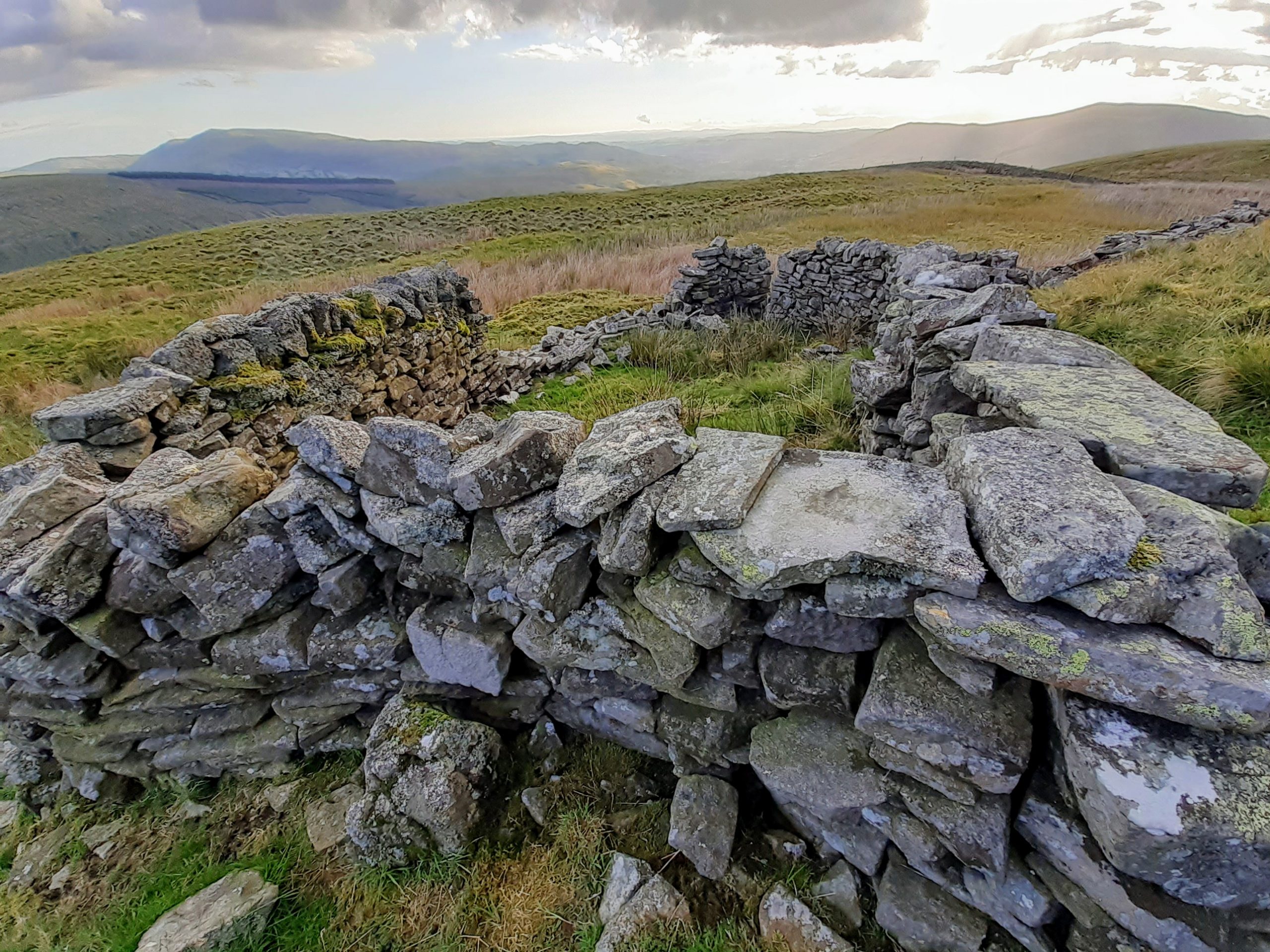


The geology of the dale is a mix of predominantly grit/sandstone, with some deeper layers of carboniferous limestone. This affects the plant species in that grow in the area. The soil is predominately thin, on a sandstone base which has enabled the formation of peat and blanket bog, much of which is now badly depleted through a combination of historic peat cutting for burning, and over grazing and erosion by sheep. Occasionally there are areas of lime/alkali loving plant species – evidence of carboniferous limestone water rising to the surface and affecting the soil and vegetation.
History
The land has been grazed by sheep and at times cattle and ponies, probably for hundreds of years and seems to have been part of Lindsey Fold Farm or other farms in the dale.
There is evidence of quarrying, probably for stone for walls and buildings. There was coal mining, slate mining and lime burning in the dale, but there isn’t a clear record of it on this land. Sadly, the slate turned out the be porous – so wasn’t a great success as a roofing material!
Uses, Damage and Changes
Extensive grazing, particularly by sheep, over centuries has depleted the vegetation and therefore the ecosystem and biodiversity. There are now just a few trees growing close to the rivers and streams, the predominant vegetation is grass and rushes on the lower slopes and rough grasses, some mosses and berries on the upper slopes.
The situation was made worse in the 1970’s when farmers were paid to create grips (manmade channels) to drain the water from the higher slopes. The aim was to create drier land, therefore better grazing and enhanced food production. This was a disaster for the peatland and blanket bog and all the species that relied on it and a disaster for carbon capture and flooding. It had a direct effect on this piece of land in the early 1990’s – after a storm so much water rushed off the high allotments that it caused severe erosion to the banks of Gillfeet Gill West and flooding. The scar on the gill can still be seen. However, as a result the farmers who owned the land at this time got a grant to fence off the lower part of the gill to prevent sheep grazing and causing further erosion and to plant an area of native woodland to stabilise the banks. This woodland has done well and, because it’s been sheep-free, there is also heather and bilberry regeneration which is now starting to spread out to the surrounding pastures.
These farmers made other environmentally friendly changes, which has meant that the peat bog is starting to return; there is now a lot of moss returning, including some sphagnum and as well as quite a lot of bilberry, there are other species like cranberry and cowberry.
There is still a lot more to be done, but this is a great start.
Meet The Trustees and our Team

Rosey Grandage:
Conservation Explorer and Land Custodian. Chair, Operations Lead and Health and Safety Lead
'I’m a physio and Chinese medicine practitioner and have worked for both the NHS and in private practice in London and Brecon. Among other things, I have been a university lecturer for 17 years and been chair of a wildlife trust. I am now Vice Chair of the Wildlife Trust of South and West Wales and a trustee for The Royal Society of Wildlife Trusts.
For 14 years I ran a community interest company art gallery, which focused on art to raise awareness of conservation and the environment and working with and mentoring young artists. We were the first gallery to show the Environmental Photographer of the Year Award exhibition and have worked with a range of conservation charities. Until Covid hit we also ran our Arts Education Programme with local schools and colleges, enabling young artists to curate and present their own exhibition; we also mentored young local artists.
Outside my work I spend as much time as I can out in the wilds - walking, listening, learning and relaxing. We live on an amazing planet and I am passionate about understanding it and caring for it and giving others that opportunity too. Having spent much of my 20's and 30's travelling the world, I lived in China for 2 years in the early 90's studying Chinese medicine and philosophy, I stopped flying in 2000 and since then have enjoyed exploring the UK.
I had been looking for some land in Mid-Wales or Cumbria, where I love to walk and have old family connections, for a few years and am very happy to have found this wonderful piece of dale and fell.'

Paul Brady:
Conservation Advisor, Trustee and Safeguarding Lead
'Born in Middlesbrough with a passion for wildlife right from the start; I studied Ecology at Lancaster University before embarking on a career as a science teacher, determined to show young people the wonders of the natural world I love. A slight career change into the charity sector with the RSPB and more recently the Yorkshire Dales National Park and Wild Ingleborough gave me the chance to work with people, bringing nature to life in their communities, on nature reserves and in the “classroom”.
I was lucky enough to grow up with the freedom to explore local green areas, the local becks, hills and beaches. Nowadays many of these places have shrunk or disappeared altogether. It is my belief that all people should have access to green spaces and, more than that, wild spaces, and better still if they can play a part in that restoration, taking ownership. So when I discovered Wild Garsdale Pike my interest was piqued'
Paul is currently Compliance Manager for the Chartered Institute of Fundraising
 Alice Slattery:
Young Trustee
Alice grew up seeing Garsdale Pike from her bedroom window, since graduating with a degree in Earth Sciences she has worked in land management and as an Environmental Scientist and has a particular interest in natural capital.
'I believe the work Wild Garsdale Pike is doing with young people for nature is brilliant! I am committed to growing the charity and providing my
technical expertise to further enhance the land and development of young people through conservation.
I am committed to environmental conservation and sustainable land
management and my academic background in Earth Sciences, coupled with my practical experience in various roles, has equipped me with a solid foundation in understanding ecological processes, natural resource management, and the application of scientific principles'
Alice is currently a Natural Capital Consultant with Savills

Sammy Haddock
Trustee
'I’ve been fortunate to always live in the lake district and graduated 2 years ago from University of Cumbria in Ambleside with a degree in Animal Conservation Science. I decided on pursuing conservation because I wanted to be in a position to help nature. Prior to uni I had done a lot of volunteering including learning to dry stone wall, remove invasive species and tackle bracken and bramble. During uni I have been able to be part of the Back On Our Map (BOOM) project, working to restore or re-introduce native species to Cumbria. This project enabled me to develop my surveying skills and work with the local community.'
Sammy is currently an Invasive Non-native Species Coordinator working along the River Kent.

Austin and Lindsay Sedgley:
Farming and Local Advisors. Austin is a Trustee.
Austin and Lindsay qualified as accountants and fell in love with the Yorkshire Dales while studying in Leeds in the 1970’s. They decided to work for four years in Zambia to save enough money to live and work in the Dales and while in Africa travelled as much as possible stimulating their interest in wild open spaces.
On returning to the UK they bought a large house and 30 acres in a remote area of Upper Wharfedale and ran it for eight years as an “ off the beaten track” guest house. In 1988 they bought Lindsey Fold, a 230 acre traditional hill farm.
The following years represented a steep learning curve about all things hill farming... understanding the uniqueness of each land holding, the realisation that, with reference to government support schemes, “ one size definitely does not fit all”, dealing with the trials of extreme weather events...yes, even 30 years ago!
While doing this Austin taught Design Technology in the local secondary school and Lindsay worked in school catering and admin.
In 2020 Lindsay and Austin decided it was time to reduce their workload and downsize and are delighted to pass on the baton of managing their area of moorland to become Wild Garsdale Pike. During the years of livestock farming at Lindsey Fold they became very aware of the conflict between managing the land profitably and minimising the damage to flora and fauna.
'It will be a great pleasure to participate in a project which will redress the balance and help educate future generations to understand the very real challenges facing local farming communities in the years to come.'
 Christine Tansey:
Biodiversity and Monitoring Lead Trustee
Christine grew up in the South Pennines and now works as a Partnership Officer on the Better Biodiversity Data project at the National Biodiversity Network Trust and is focused on facilitating a
better infrastructure for biodiversity data in Scotland.
'I am supporting the work of Wild Garsdale Pike because I recognise the richness of experience that such a charity can provide to young people, whether they already have a spark of interest or are inspired by a new
connection to nature.
I am drawn to the approach of Wild Garsdale Pike in enabling young people to access the land and empowering them to shape the conversations and decision-making around its future. My experiences of volunteering in conservation and land management as a student were formative, and I am motivated by the prospect of supporting a charity that offers similar opportunities to younger people.'
Christine is currently the Partnerships Support Officer with The National Biodiversity Network

Emily Franke:
Wildlife Film and Media Advisor
After studying biology and trying my hand as a field assistant in the wilds of British Colombia I moved into the world of wildlife television. Over the past twelve years I have been lucky enough to work on documentaries for BBC, ITV, Nat Geo, Discovery Channel and Netflix as well as a stint down under as an impact producer for SBS Australia. By sharing the stories of the amazing humans and wildlife I meet, I hope to inspire myself and others to make more positive choices for this amazing planet we call home
Our Partners:
Latest News


Creative WGP
Showing some of the amazing art, photography, poetry and ideas that Wild Garsdale Pike has inspired
-

- Poem by Muhammed

-

- Poem by Muhammed Amin

-

- Map of a Future Garsdale Pike Created by the Youth Leadership Group 2021 – 22

-

- Drawing by Seren

-

- Drawing by Seren

-

- Drawing by Seren

-

- Photo by Tamar

-

- Photo by Tamar

-

- Photo by Tamar

-

- By Myrtle

-

- By Myrtle


Contact Us